
Blog Post
Tented, Treehouse, and Cabin Retreats: Wellness in Structures That Disappear Into the Land
Retreats
April 21, 2026
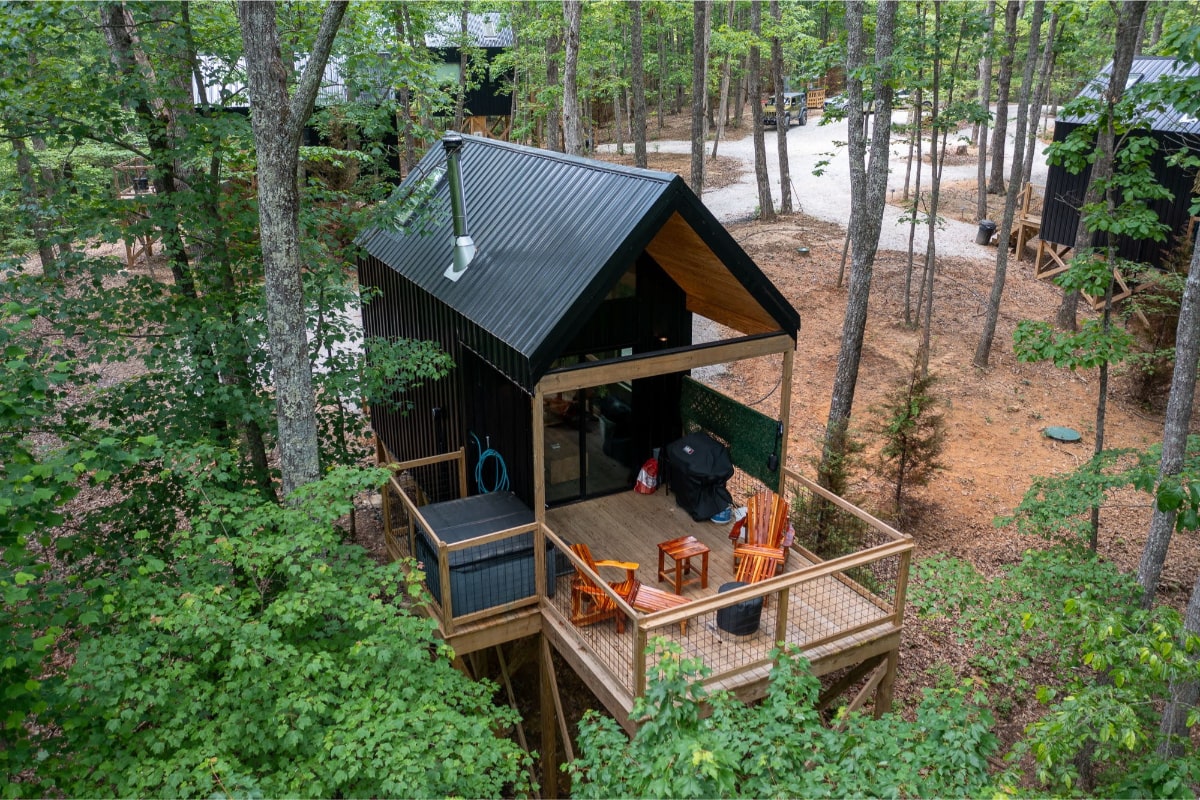
The first thing a retreat's architecture asks you is how much it plans to get in the way.
A large hotel resolves the question in one direction. Marble, glass, columns, a lobby the size of a chapel. The building is the announcement. The land is the backdrop. The spa is a room on the second floor with recessed lighting and a steam shower. Nothing wrong with that in principle. It's just a different product than what we're looking at here.
The retreats on this list resolve the question the other way. They're built to disappear. Canvas walls that roll up into nothing. Timber structures that sit on stilts above the forest floor so the understory keeps growing beneath them. Lodges sunk into hillsides with roofs covered in grass. The architecture functions as a lens on the place, which is a different project than functioning as a destination.
The wellness effect of this kind of building is underrated. A room that opens completely to a forest doesn't require you to do anything for the forest to reach you. A bed that faces a cliff over the Atlantic doesn't need a meditation app. The environment becomes the program. The structure gets out of the way.
Ten retreats, grouped by the kind of structure they chose.
Under Canvas
Tented retreats are the clearest form of the idea. Soft architecture, modular, removable. The tent translates scale and permanence into something the site can carry without being altered. The best tented retreats take advantage of that: canvas roll-up walls, wraparound decks, no hard separation between the tent and the ground it sits on.
Four Seasons Naviva (Punta Mita, Mexico) is one of the most considered tented properties to open in the Americas in recent years. Luxury Frontiers designed the 15 bungalows with canvas roll-ups instead of walls, converting the living areas into rooms that open fully to the jungle when the weather allows. The build uses locally sourced bamboo, copper, and indigenous stone. The landscape architects (EDSA) worked from a tree-by-tree survey of the site and hand-placed the tents between roughly 1,800 preserved existing trees, with another 345 native species planted after construction. The welcome experience, a timber bridge covered in a lattice bamboo weave that opens into a copper-shingle cocoon, is a clear statement of the design language: structures that frame the land without competing with it.
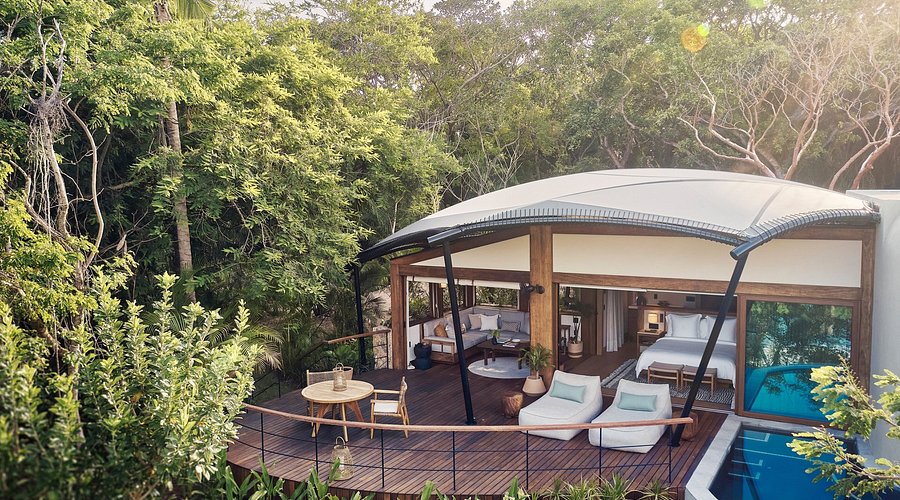
Longitude 131° (Uluru, Australia) runs 16 tented pavilions on stilts above the desert floor, each one oriented toward Uluru. The design (floor-to-ceiling windows, raw timber, a high canopied roof) lets you wake up with the rock in frame without ever leaving the bed. The pavilions are close enough to feel connected to each other and far enough apart to stay private. The desert works on guests in the way the jungle works at Naviva, as a primary therapeutic presence that the architecture doesn't distract from.
Clayoquot Wilderness Resort (British Columbia, Canada) occupies a stretch of Bedwell Sound on the west coast of Vancouver Island, reachable only by floatplane or boat. 25 white tents rise from wooden platforms in a cedar forest at the water's edge. The decor leans turn-of-the-century safari (Persian rugs, antique writing desks, clawfoot tubs), but the tents themselves are canvas, tied to the land rather than placed on it. Wolves have walked through the camp. Black bears fish in the river. The property's wellness program (yoga, forest bathing, cold-water dips in the sound) treats the rainforest as the principal treatment.
Shinta Mani Wild (Cambodia) sits in 400 acres of private rainforest along the Tmor Rung River in the Cardamom Mountains. The 15 tents are stilted platforms designed by Bill Bensley, each one themed around an episode in King Sihanouk and Jackie Kennedy's 1967 Cambodian travels, each with an outdoor tub positioned over the riverbank. The property's conservation purpose (Bensley purchased the logging rights to protect the jungle) sits at the center of its wellness identity. The 1,050-foot zipline arrival, which drops guests over the canopy and into the Landing Zone Bar, is the most photographed entrance in luxury travel.
Elevated
Treehouses and stilted structures take the same idea a step further. The ground stays undisturbed. The forest continues below. You live in the canopy.
Post Ranch Inn Tree Houses (Big Sur, California) are among the earliest high-end expressions of the form. Mickey Muennig designed the Tree Houses in the mid-1990s to sit 9 feet above the forest floor on triangular stilts, so that the root systems of the oaks and redwoods wouldn't be disturbed by the construction. The interiors are small, warm, wood-lined. The windows open to cliff views over the Pacific.
The architecture is older than most of the wellness vocabulary we now use to describe it, but the principle (buildings that touch the land as lightly as possible) has held up as well as anything the newer properties have built.
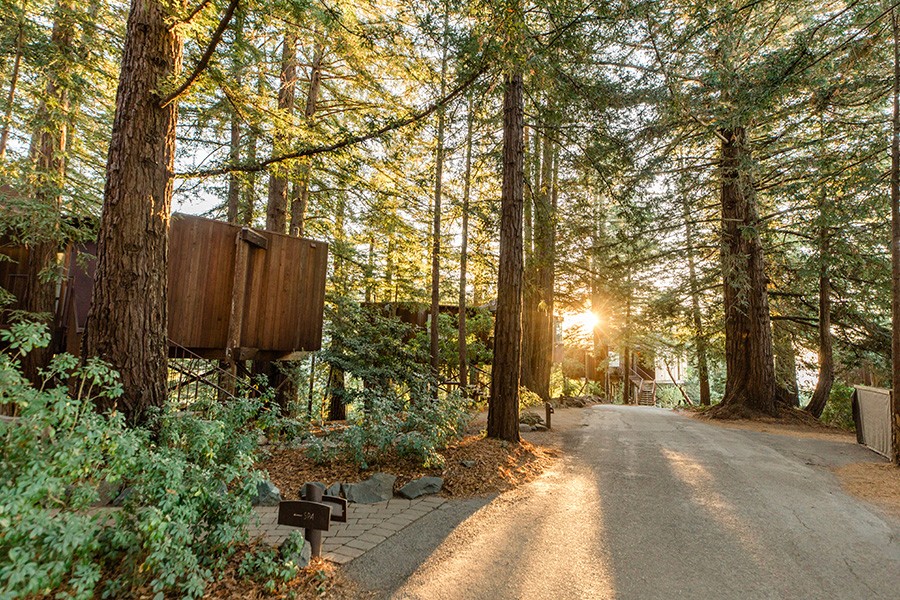
Bawah Reserve (Anambas Islands, Indonesia) holds 35 bamboo-and-thatch suites across six islands in a private archipelago, reachable only by seaplane from Batam. 11 of the suites are overwater on the largest island's lagoon, built entirely without the use of heavy machinery during construction. The materials (bamboo, recycled teak, copper, grass roofs) were chosen to let the buildings decompose eventually if the reserve were ever abandoned. The spa program uses the ocean as its primary environment: open-water swimming, coral snorkeling as mindfulness practice, salt-air treatments. The property's founder set aside a permanent marine protected area around the islands, which the wellness experience is inseparable from.
Fogo Island Inn (Newfoundland, Canada) cantilevers off the northern edge of Fogo Island on steel stilts, suspended over rock and ocean. Todd Saunders designed the building to look like a fishing stage, the traditional structure used by outport cod fishermen, enlarged and lifted. The wellness experience here is atmospheric rather than programmatic. The roof has a sauna and rooftop hot tubs facing the Atlantic. The rooms have beds positioned at the windows. The quiet on the island is the kind that takes a day or two to start to register.
Into the Land
The third group of retreats takes the opposite architectural strategy: instead of lifting off the ground, they sink into it. Lodges absorbed into hillsides, buildings designed to disappear from the landscape rather than above it.
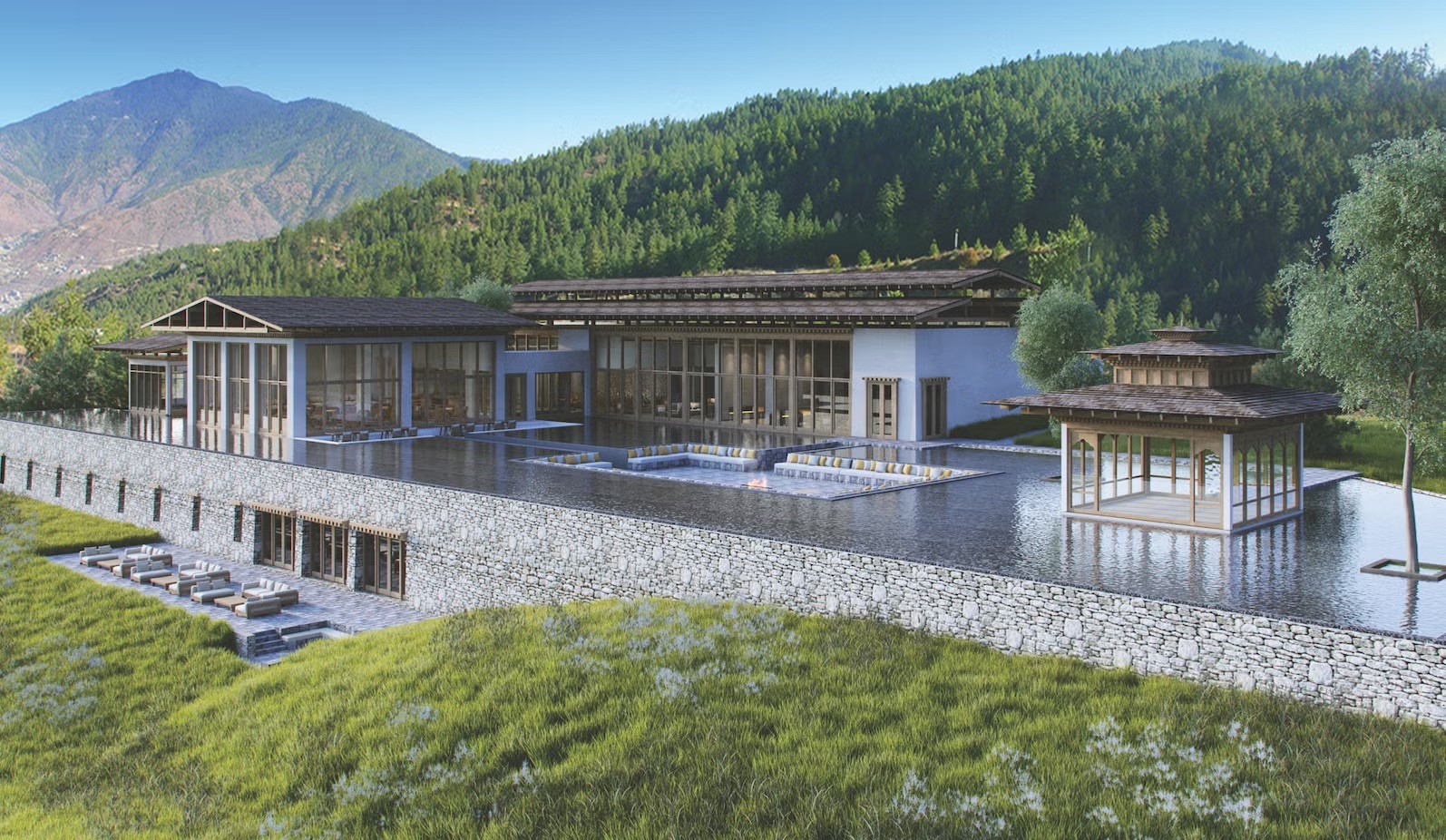
Six Senses Bhutan (five lodges across Bhutan) runs as a single circuit spread across Thimphu, Punakha, Paro, Gangtey, and Bumthang. Each lodge was designed to fit its specific valley: the Thimphu lodge arranged around a central stone courtyard, Punakha set into rice terraces, Gangtey oriented toward the black-necked crane migration fields. The architecture uses local stone, timber, and clay, and the roof lines follow Bhutanese dzong traditions. The wellness programming (yoga, Bhutanese singing bowls, alpine hikes, nunnery visits) runs across the whole circuit, so that a stay is structured as a moving retreat rather than a single stop.
Amanemu (Ise-Shima, Japan) sits at the edge of Ago Bay in Japan's Ise-Shima National Park, with 24 suites and 4 villas built in a contemporary ryokan vocabulary. Low-slung roof lines, timber and stone interiors, sunken hinoki baths in every suite fed by the onsen beneath the property. The surrounding forest and pearl-farmed bay are the setting. The spa uses the mineral waters as the primary treatment, and the architecture treats the bath as the central feature of each room. Nothing about the property announces itself. It reads as a series of adjacent cottages that happen to have opened onto a Japanese national park.
The Brando (Tetiaroa, French Polynesia) isn't technically cabin architecture, but the design intent puts it in this category. 35 villas spread along a private atoll that was Marlon Brando's personal island, built with materials and layouts chosen to leave the existing vegetation untouched. The buildings are low, thatched, set back from the beach. The resort runs on a closed-loop energy system that uses cold seawater pumped from the deep ocean for air conditioning. The design wins awards for sustainability, but the guest experience of it is the quiet. The island has one hotel and one restaurant, and the atoll is otherwise untouched.
What These Retreats Share
The category has a few qualities in common.
They leave the ground alone. Stilts, cantilevers, canvas, shallow foundations. The architecture treats the undisturbed land as a premium feature rather than a starting point to be graded. The wellness effect of that is easy to feel and hard to fake.
They use soft materials. Canvas, bamboo, thatch, grass, timber. These are materials that age and eventually return to the earth. They also carry sound and temperature differently than concrete and glass. A tented wall moves in the breeze. A timber roof creaks as the day cools. The senses stay engaged in a way that sealed buildings don't allow.
They're in remote places. Not always, but usually. The operational cost of running a luxury retreat on a private archipelago or a protected jungle reserve is enormous, and it gets passed on. But the remoteness is part of what the architecture makes possible. You can build a tent camp with no walls because the nearest town is a three-hour boat ride away. The design and the location reinforce each other.
They treat the building as part of the practice. Yoga on the deck of your tent is different than yoga in a studio. A soaking bath fed directly from a hot spring beneath your floor is different than a bath in a bathroom. The architecture operates as part of the wellness program, not as set dressing around it.
The retreats that stay on editorial lists year after year tend to be the ones that understood this early. The buildings aren't meant to be noticed. They're meant to put you in a place where the noticing happens on its own.