
Blog Post
A Beginner's Guide to Vipassana Meditation Retreats
Retreats
April 10, 2026
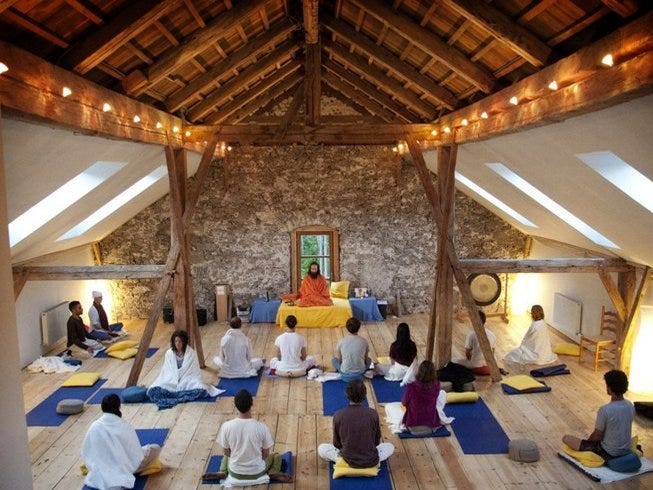
Vipassana is a 10-day silent meditation retreat where you wake up at 4am, meditate for 10+ hours a day, don't speak, don't read, don't write, don't exercise, don't make eye contact, eat only breakfast and lunch (no dinner, just tea and fruit in the evening), and sleep on a thin mattress in a dormitory. There's no music, no phone, no internet, no books. You surrender your devices at check-in.
It costs nothing. The retreats are funded entirely by donations from previous participants. You don't pay until after you've completed the course, and only if you feel the experience was valuable enough to support.
About 25% of first-time participants leave before day 10.
Here's what you're signing up for.
The Tradition
Vipassana means "to see things as they really are" in Pali (the liturgical language of Theravada Buddhism). The technique is attributed to Siddhartha Gautama (the historical Buddha), who taught it roughly 2,500 years ago in northern India. It was preserved in the Theravada Buddhist monasteries of Myanmar (Burma) for centuries and largely unknown in the West until the 1960s and 1970s, when S.N. Goenka, a Burmese-Indian businessman-turned-teacher, began teaching 10-day courses to lay practitioners.
Goenka's model is the one you'll encounter at most Vipassana retreats today. He established a global network of centers (over 200 worldwide, managed by the organization Dhamma.org) that all follow the same format: 10-day courses taught via Goenka's recorded audio instructions (he died in 2013, but the recordings continue to guide all courses). The teaching is secular in presentation, though the philosophical framework is Buddhist. Goenka repeatedly emphasizes that Vipassana is a technique, not a religion, and participants of all faiths (or no faith) are welcome.
The Schedule
Every day follows the same structure:
4:00am: Wake-up bell.
4:30-6:30am: Meditation in the hall or in your room.
6:30-8:00am: Breakfast and rest.
8:00-9:00am: Group meditation in the hall (mandatory attendance).
9:00-11:00am: Meditation in the hall or in your room.
11:00am-1:00pm: Lunch and rest.
1:00-2:30pm: Meditation in the hall or in your room.
2:30-3:30pm: Group meditation in the hall (mandatory attendance).
3:30-5:00pm: Meditation in the hall or in your room. 5:00-6:00pm:
Tea break (fruit and tea for new students; old students receive only lemon water).
6:00-7:00pm: Group meditation in the hall (mandatory attendance).
7:00-8:15pm: Goenka's evening discourse (a recorded video lecture explaining the technique and philosophy).
8:15-9:00pm: Final meditation. 9:00pm: Retire to your room.
9:30pm: Lights out.
That's roughly 10.5 hours of seated meditation per day. The three mandatory group sittings (called "sittings of strong determination") are 1 hour each, during which you're instructed not to move, open your eyes, or uncross your legs. The other meditation periods can be done in the hall or in your room, and the intensity is up to you, but the expectation is that you're meditating, not napping.
The Technique
The course teaches Vipassana in stages across the 10 days.
Days 1-3: Anapana. You focus on the sensation of breath at the nostrils. That's it. Air coming in, air going out. When your mind wanders (and it will, constantly, aggressively, creatively), you notice that it wandered and bring attention back to the breath. The purpose is to sharpen concentration (samadhi) before introducing the core technique. These 3 days feel endless. Your mind generates an astonishing volume of thoughts, memories, plans, fantasies, and complaints. The practice is simply to notice them and return to the breath.
Days 4-7: Vipassana proper. You begin scanning your body systematically, moving attention from the top of the head to the tips of the toes and back, observing whatever physical sensations arise. Tingling, heat, pressure, pain, numbness, pulsing. The key instruction is equanimity: observe the sensations without reacting. Pleasant sensation? Don't crave more of it. Painful sensation? Don't resist it. Just observe. The technique is based on the premise that physical sensations are the body's expression of mental conditioning (sankhara), and that observing them without reaction gradually dissolves the conditioning.
Days 8-9: Deepening. The body scanning becomes subtler. You're looking for sensation in areas where you previously felt nothing. The "blank spots" (areas of the body where you can't detect sensation) are considered areas of accumulated conditioning. As concentration deepens, sensation becomes more continuous and flowing. The discourse lectures frame this as the process of purification: old mental patterns rising to the surface as sensation and dissolving through equanimous observation.
Day 10: Metta. Noble silence is broken in the morning. You can speak with other participants for the first time. The final meditation introduces metta (loving-kindness): extending goodwill to yourself, to the people in the room, to all beings. After 9 days of intense internal work, the metta practice is surprisingly powerful. Many participants cry.
What the Silence Is Like
Noble silence means no talking, no gestures, no eye contact, no written communication. You share a dormitory and a dining hall with other people and pretend they don't exist. It sounds oppressive. In practice, it's a relief.
Without conversation, the social performance that occupies most of daily life disappears. You don't have to be interesting, agreeable, or polite. You eat alone. You walk alone. You sit with your own mind for 10 days, and whatever you find there, you can't escape it by talking about it.
The first 2-3 days of silence are uncomfortable. Your mind craves stimulation and interaction. By day 4, the silence becomes normal. By day 7, the thought of talking feels intrusive. When silence breaks on day 10, many participants describe the return of conversation as jarring, even overwhelming.
The Hard Parts
Physical pain. Sitting cross-legged on a cushion for 10+ hours a day produces real physical discomfort. Knee pain, back pain, hip pain, neck pain. The "sittings of strong determination" (1 hour without moving) can be excruciating by day 3. Additional cushions and back supports are available, and the technique itself teaches you to observe the pain without reacting, which sometimes reduces its intensity. Sometimes it doesn't. The pain is not an accident; it's part of the training.
Mental resistance. Your mind will generate every possible reason to leave. "This is a cult." "My back is going to be permanently damaged." "I have important work to do." "This is stupid." "I could be at the beach." The volume of resistance peaks around day 2-3 and again around day 6-7. The trick is recognizing the resistance as another thought pattern and returning to the technique.
Emotional intensity. Vipassana can surface suppressed emotions with startling force. Grief, anger, fear, and sadness can arise during meditation without an obvious trigger. The technique's response is the same as for physical pain: observe, don't react. Some participants describe intense crying, shaking, or emotional release during meditation periods. The assistant teachers are available for brief, technique-focused questions during designated break times if you're struggling.
Boredom. 10 days without a phone, a book, or a conversation is more boring than most modern humans have ever experienced. The boredom peaks around day 4-5 and then transforms into something else: a quiet awareness that doesn't require stimulation. Getting through the boredom is, in some ways, the point.
Is It Worth It?
The experience is polarizing. Some people describe their first Vipassana retreat as one of the most transformative experiences of their lives: a fundamental shift in how they relate to their thoughts, emotions, and physical sensations. Others describe it as 10 days of suffering that produced nothing except sore knees and a strong desire to never sit on a cushion again.
The people who benefit most tend to share a few traits: they already have some meditation practice (even informal), they're genuinely curious about their internal experience rather than seeking a specific outcome, and they're willing to commit fully to the technique for 10 days even when it feels pointless.
The people who struggle most tend to be those who sign up expecting a transformative breakthrough and spend the retreat evaluating whether they're having one.
How to Sign Up
All Goenka Vipassana courses are booked through dhamma.org. Courses fill up weeks or months in advance (especially at popular centers), so plan ahead. The application asks about your meditation experience, mental health history, and physical limitations. People with a history of psychosis, severe depression, or recent major trauma may be asked to wait or may not be accepted.
Centers exist on every continent. The largest in North America are in Massachusetts (Dhamma Dhara), California (Dhamma Mahavana), Texas (Dhamma Siri), and Georgia (Dhamma Patapa). In Asia, India has the highest concentration (including Dhamma Giri in Igatpuri, the international headquarters). Southeast Asia has centers in Thailand, Myanmar, Nepal, and Sri Lanka.
There is no fee to attend. At the end of the course, you're invited to donate whatever amount feels appropriate to support future students. There's no suggested amount and no pressure. Some people donate nothing. Some people donate generously. The model has sustained over 200 centers worldwide for decades, which suggests it works.
Vipassana asks you to do the simplest and most difficult thing in the world: sit still and observe what happens. Everything else is commentary.