
Blog Post
The Best Glamping Resorts in Mexico, from Baja to Bacalar (2026)
Retreats
September 15, 2026
Joshua Anderson
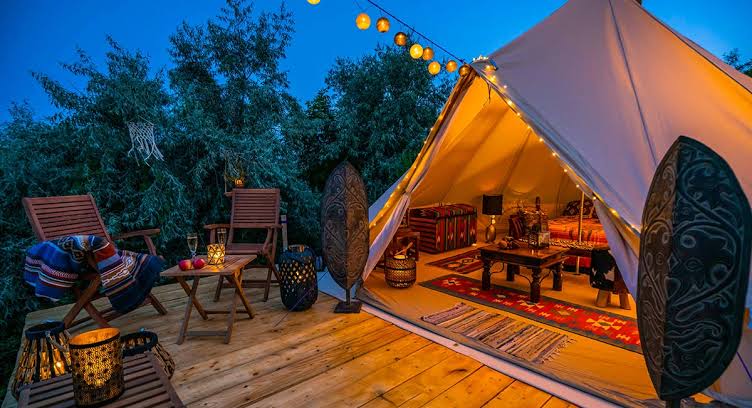
Mexico's glamping scene is smaller, more rustic and a good deal cheaper than its luxury-resort scene, and the two get confused constantly. A thatched A-frame on the Bacalar shore and a tented bungalow with a private plunge pool are both sold as glamping. They are different holidays at very different prices: the cheapest bed on this list goes for 450 MXN a night, and the most expensive is an all-inclusive Four Seasons.
This list covers the range. One entry is an all-inclusive Four Seasons where the rate includes every meal and a 90-minute spa journey. Another is a fixed-departure camp where fifteen tents share five bathrooms and the kitchen is run by the family that has looked after the site for thirty years. Both are worth the money. Neither substitutes for the other.
Each entry says what you actually sleep in, because that's the detail most guides skip. Canvas walls, a geodesic dome, a palapa roof and a bamboo treehouse are not the same experience in August.
At a glance
Best ultra-luxury glamping: Naviva, A Four Seasons Resort
Best wine-country glamping: Casa Misiones Glamping
Best adventure glamping: Bahía Magdalena Ocean Camp
Best lagoon-front value: Glamping Asana Bacalar
Best eco-beach glamping: Playa Viva
Best for families: Las Estacas
Methodology in brief
We ranked for a glamping trip specifically, which means the structure you sleep in counts for more than the thread count. Every factual claim below is checkable against the property or an independent source.
Criterion | What it captures |
What you sleep in | Canvas, dome, palapa or treehouse, and whether the walls are soft or solid. A cabin is not glamping. |
Book-ability | Whether you can reserve it, and through which channel. Some of Mexico's glamping sells only over WhatsApp, and some of what appears in search results is no longer trading. |
Rates, with the date we saw them | Published rates, currency stated, checked in September 2026. Small operators change rates without notice. |
Setting and region | A spread across Baja California, Baja California Sur, the Pacific coast, Morelos and the Yucatán peninsula. |
Honest tradeoffs | Shared bathrooms, no air conditioning, seasonal closures and construction noise are all named where they apply. |
Verifiability | Unit counts, opening years and awards checked against first-party sources. Where a property publishes nothing, we say so. |
What counts as glamping, and what doesn't
The word covers a wide range in Mexico, and the price range is wider still. Three rough tiers are useful when you're comparing.
True tented camps put you under canvas. Walls flex in the wind, you hear everything outside, and the bathroom may be a walk away. This is the original article and it runs from about 1,500 MXN a night to the top of the market.
Structured glamping means a fixed shelter that isn't a hotel room: a geodesic dome, a bamboo treehouse on stilts, a palapa-roofed casita open on one side. You get a private bathroom and a door that locks. Most of Mexico's glamping sits here.
Tented luxury is a resort that happens to use canvas. Full service, a plunge pool, a restaurant, a spa. Naviva is the clearest example in the country, and it costs accordingly.
One planning note that applies across all three: very little of Mexico's glamping has air conditioning. Check before you book anything between May and October.
1. Naviva, A Four Seasons Resort: Best ultra-luxury glamping
Fifteen tented bungalows on 48 forested acres, with a hard cap of thirty guests.
Location: The edge of the private Punta Mita peninsula in Nayarit, 45 minutes from Puerto Vallarta airport.
What you sleep in: Canvas-and-timber tented bungalows, 116 to 160 square metres, each with a king bedroom and a private plunge pool.
Best for: Couples who want the wilderness setting without giving up the service.
Rates: All-inclusive. Confirm with the resort.
Don't miss: The House of Heat temazcal, led by a curandero, and the free-diving breathwork session that ends in a PADI certification.
Overview
Naviva, A Four Seasons Resort opened in December 2022 with fifteen luxury tented bungalows spread across 48 forested acres. The number that matters is on the other side of that ratio: the property serves a maximum of thirty guests, which works out to roughly 1.6 acres each. Luxury Frontiers designed the bungalows and EDSA handled the landscape. There's no check-in desk. You arrive on foot across a copper-and-bamboo bridge spanning a nine-metre forest ravine, into a woven bamboo tunnel shaped like a chrysalis.
The rate covers every meal, every drink including premium wines and spirits, and one 90-minute spa journey per guest per stay. Cocina Copal cooks over open fire at the centre of the camp and works without a set menu. Condé Nast Traveler named it to its 2023 Hot List, Travel + Leisure to the 2023 It List, and it joined 50 Best Discovery in July 2026. Guests must be at least 16.
Downside: the property is built into a hillside and it's stair-heavy, so mobility is a real consideration. There's also only one restaurant on site, and La Solana beach is rocky and meant for walking, not swimming. Four Seasons Resort Punta Mita, five minutes away, is where guests go to swim.
2. Casa Misiones Glamping: Best wine-country glamping
Six safari tents on a working Nebbiolo vineyard, capped at about twelve adults.
Location: Villa de Juárez, in the Valle de Guadalupe, Baja California. 36 minutes from Ensenada, about an hour and a half from Tijuana.
What you sleep in: Safari tents of 384 square feet, each with a private indoor bathroom, air conditioning and heating, and its own outdoor deck chimney.
Best for: Couples touring the valley who'd rather stay on a vineyard than in town.
Rates: Roughly 1,890 to 4,758 MXN per night before tax, depending on the tent and the day of the week (seen September 2026).
Don't miss: The estate tasting, poured by the owner who made the wine.
Overview
Casa Misiones runs six tents named after Spanish missions, on about five acres. What separates it from the valley's other lodgings is that the vineyard is real. The owners planted their own Nebbiolo block and make four distinct tiers of wine from it in small lots, poured mostly for guests. That production scale exists precisely because the property caps at roughly twelve adults. The owner-winemaker hosts the tastings himself and sends people off with recommendations for the surrounding wineries, of which there are ten within fifteen minutes.
The property is adults-only, couples-only, with a minimum check-in age of 21 and a two-night minimum.
Downside: the tents have no insulation and the site catches noise from its neighbours. The owner has said both things publicly, responding to a guest complaint about dogs and a neighbouring property's music running to 3am, and his practical answer was to offer free earplugs. Guests also describe the access road as rough and poorly lit after dark.
3. Bahía Magdalena Ocean Camp: Best adventure glamping
Fifteen air-conditioned tents on a Pacific sandbar, sold as a four-day expedition.
Location: Médano Amarillo, on Bahía Magdalena, Baja California Sur. Trips depart from La Paz.
What you sleep in: Jupe tents with queen beds, air conditioning, lighting and a power outlet. Bathrooms are shared.
Best for: Grey whale season, and anyone who'd rather be guided than left alone.
Rates: 28,950 MXN per person, double occupancy, for four days and three nights (seen September 2026).
Don't miss: The oyster farm next door, visited on day three, where the shellfish comes out of the water minutes before you eat it.
Overview
Bahía Magdalena Ocean Camp is run by Akampa, a Mexican conservation-tourism company, in partnership with Viatura. You don't book a room here, you book a departure: four days and three nights, meeting at 11am in downtown La Paz, with ground transport, nine meals, two ocean safaris of six hours or more with a marine biologist aboard, and the oyster-farm visit all included. The kitchen is run by the family that has cared for the site for thirty years, and Akampa is explicit that the camp exists to create work in San Carlos and Ciudad Constitución.
Grey whale departures for 2027 run from 15 January to 22 April. Humpback season runs December into January, and the marlin and sardine run fills October through December. Worth knowing before you go: swimming with grey whales is prohibited in the calving sanctuaries under Mexican law, so viewing is from the boat.
Downside: fifteen tents share five bathrooms, and there's no en-suite option at any price, including the single-occupancy rate. The camp closes roughly May through September, cell signal is effectively absent, and you cannot book a single night.
4. Glamping Asana Bacalar: Best lagoon-front value
Thatched A-frames on the shore of the Seven Colours Lagoon, from 450 MXN a night.
Location: Highway 307 at km 22.5, about 3 km north of Bacalar town, Quintana Roo. Chetumal airport is roughly 40 minutes away; Cancún is nearly five hours.
What you sleep in: Rigid open-gabled A-frames of about 7 square metres, roofed in thatched palm, with a fan and a mosquito net. Bathrooms are shared.
Best for: Getting on the lagoon cheaply, and swimming before breakfast.
Rates: 450 to 780 MXN per cabin per night, breakfast included (seen September 2026).
Don't miss: The panga tour from the property's own dock, which runs daily except Wednesdays.
Overview
Glamping Asana Bacalar occupies a narrow strip of shore between Highway 307 and the water, which is the whole proposition: you go from bed to dock to lagoon in about twenty paces. The rate covers breakfast, unlimited use of the kayaks, bicycles, Starlink wifi, a shared kitchen and sunrise yoga on the pier. The panga tour calls at the Canal de los Piratas, Cenote Negro, Cenote Esmeralda, Isla de los Pájaros and Bahía Escondida, and it doesn't sail on Wednesdays, which is the day Bacalar's boat operators voluntarily keep the lagoon quiet.
Be clear about what this is. The property sells 8-bed dormitory beds alongside the cabins, and the cabins are rigid huts. No canvas. Its own Spanish-language copy calls them cabañas. TripAdvisor ranks it second of 103 specialty lodgings in Bacalar on 48 reviews, and Hostelworld guests score it 9.5.
One rule to know before you swim: Bacalar's municipal ecology directorate prohibits all sunscreen in the water, biodegradable included, because it feeds the nutrient load that has been browning the lagoon. Stromatolites, the living microbial reefs that run more than 10 km along this shoreline, are to be kept at a distance of three metres and never stood on.
Downside: the cabins back onto Highway 307 and guests report road noise at night. Cleanliness is the weakest of its scores, at 8.6 on Expedia against 9.8 for service. There's no air conditioning, and hot water is not something the property commits to anywhere.
5. Playa Viva: Best eco-beach glamping
Bamboo treehouses built around living palms, on a mile of private Pacific beach.
Location: Juluchuca, Guerrero, 35 to 45 minutes from Zihuatanejo airport.
What you sleep in: Treehouses, palapa-roofed casitas and suites. These are open-air and screened. No canvas. Only one of the rooms has air conditioning.
Best for: Travellers who want the sustainability claims to hold up to checking.
Rates: 320 to 745 USD per night, low season, double occupancy, all-inclusive of meals (seen September 2026).
Don't miss: A sunrise hatchling release at the turtle sanctuary.
Overview
Playa Viva opened in 2008 on about 200 acres with roughly a mile of private beach, an estuary and an Aztec archaeological site. David Leventhal and Sandra Kahn founded it after deciding not to subdivide the land. The five Manta treehouses, designed by Atelier Nomadic, are built on and around living palm trees that keep growing through the structures, with rooflines shaped after the mobula rays that leap offshore. They won an AHEAD Global award in 2022 and a Dezeen sustainability award the same year.
The environmental record holds up better than most. The property runs entirely off-grid on solar, draws water from its own well, grows food on a 20-acre permaculture farm, and treats its wastewater on site. It holds two Michelin Keys from the 2025 Mexico selection, and it certified as a B Corp in January 2023 with a score of 110, against a passing threshold of 80. The detail nobody markets is the best evidence: Playa Viva has published annual social and environmental impact reports as public PDFs since 2018. The on-site turtle sanctuary, staffed by volunteers from Juluchuca, has released more than 450,000 hatchlings since 2010, with nesting peaking July through October.
Downside: exactly one room on the property has air conditioning, and the resort's own FAQ warns about mosquitoes at dusk and sand fleas in dry sand. Tap water is not filtered or drinkable. The property also closes every August and September, and wifi reaches the common areas only.
6. Las Estacas: Best for families
Thirty-five tents inside a river park, with the run of it after the day visitors leave.
Location: Tlaltizapán, Morelos, about 1.5 to 2 hours from Mexico City.
What you sleep in: Tents with king beds and mosquito nets, private bathrooms with hot water, and a fan. No air conditioning anywhere.
Best for: Families with children who want to swim somewhere clear and warm.
Rates: 3,125 to 3,660 MXN per night, double occupancy, depending on the day (seen September 2026).
Don't miss: The river itself, which runs at a constant 23°C year-round.
Overview
Las Estacas sits on a spring where rainwater filtered through Morelos limestone resurfaces at 6,700 litres per second. The park runs the glamping itself. Thirty of the tents are standard, sleeping up to four; the other five are suites, raised about a metre off the ground with a private bathtub and fire pit, and those are adults-only.
The real advantage is timing. Guests get into the park from 8am on arrival day, six hours before the 3pm check-in, and stay on past the 18:00 close for programming day visitors can't buy: an open-air cinema, a guided night walk, an acoustic concert, campfires. For a couple of hours at each end of the day you have a 652-hectare river park largely to yourself. For children there are dedicated pools, a children's lake, paddleboards, and diving courses that start at age 8.
Downside: the park is running a construction programme through 31 January 2027 and says so on its own booking page, warning of noise and partial closures in some green areas. Note too that the five suites are 18+, so families are limited to the standard tents.
Frequently asked questions
What are the best glamping resorts in Mexico?
Naviva, A Four Seasons Resort (ultra-luxury), Casa Misiones Glamping in the Valle de Guadalupe (wine country), Bahía Magdalena Ocean Camp in Baja California Sur (adventure), Glamping Asana Bacalar (lagoon-front value), Playa Viva in Guerrero (eco-beach) and Las Estacas in Morelos (families).
How much does glamping in Mexico cost?
Anywhere from about 450 MXN a night to the top of the luxury market. Independent operators mostly run 450 to 4,800 MXN per night. Playa Viva starts at 320 USD low season with all meals included. Bahía Magdalena sells a four-day expedition at 28,950 MXN per person. Naviva is all-inclusive at Four Seasons rates.
Does glamping in Mexico have air conditioning?
Usually not. Of the properties here, only Casa Misiones has air conditioning in every unit, and Playa Viva has it in one room of nineteen. Las Estacas, Glamping Asana and most of the country's smaller operations run on fans. Bahía Magdalena is the exception among the camps, since its tents are air-conditioned. Check before booking anything between May and October.
Do glamping tents in Mexico have private bathrooms?
It varies, and it's the first thing to check. Casa Misiones, Las Estacas and Playa Viva all have private bathrooms. Bahía Magdalena Ocean Camp and Glamping Asana Bacalar both use shared facilities, with no private option at any price.
When is the best time of year to go glamping in Mexico?
November to April, for most of the country. That window is drier and cooler, which matters when almost nothing has air conditioning. It also lines up with grey whale season in Baja, which runs roughly mid-January to April. Two properties here close seasonally: Playa Viva shuts every August and September, and Bahía Magdalena operates October to April only.
Can you go glamping in Mexico with children?
Yes, though several properties are adults-only. Las Estacas is the strongest family option, with children's pools, a children's lake and diving courses from age 8, but note that its five suites are 18+, so families book the standard tents. Glamping Asana welcomes children. Casa Misiones is adults-only with a minimum age of 21, and Naviva requires guests to be 16 or over.
What is glamping like in Bacalar?
Bacalar's draw is the Lagoon of Seven Colours, whose shallow water over a white carbonate bottom produces the shades it's named for, and whose stromatolites form the largest freshwater microbialite occurrence in the world, running more than 10 km. Rules apply in the water: the municipal ecology directorate prohibits all sunscreen including biodegradable, stromatolites must be kept at three metres and never touched, and boats voluntarily stay off the lagoon on Wednesdays.