
Blog Post
Sound Healing: What It Is, What It Does, and Where to Try It
Rituals
April 10, 2026
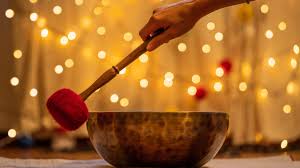
You lie on the floor with your eyes closed and someone starts hitting bowls. That's the reductive version. The longer version involves vibrational frequency, resonance, entrainment, and a 5,000-year history of using sound for therapeutic purposes. But the experience, at its most basic, is this: you lie down, sounds happen, and something shifts.
Sound healing has moved from the fringe to the mainstream faster than almost any other wellness modality. Studios in major cities offer weekly sessions. Retreat centers include it on their schedules between yoga and breathwork. Spotify has "sound bath" playlists with millions of streams. The question isn't whether it's popular. The question is whether it does anything.
What a Sound Bath Actually Is
A sound bath is a group or individual experience where you lie on a mat (usually with a blanket and bolster) while a practitioner plays instruments designed to produce sustained, resonant tones. The session typically lasts 45-75 minutes. You don't do anything. You just receive the sound.
The instruments vary, but the core toolkit includes:
Singing bowls (Tibetan or crystal). Tibetan singing bowls are metal alloy bowls struck or rubbed with a mallet to produce a rich, layered tone. Crystal singing bowls are made from crushed quartz, heated and molded into a bowl shape, and produce a purer, more sustained tone. Each bowl is tuned to a specific note, and practitioners use sets of bowls tuned to different frequencies.
Gongs. Large bronze or brass discs that produce a wide range of overtones when struck. A skilled gong player can create sounds that feel like they're moving through your body. The volume can be intense.
Tuning forks. Metal forks calibrated to specific frequencies, placed near the body or on specific points (similar to acupuncture points). Some practitioners use weighted tuning forks directly on the body, where the vibration is felt physically rather than just heard.
Chimes, drums, and voice. Supplementary instruments that add texture. Frame drums (played near the head or body), Koshi chimes, and the human voice (overtone singing, chanting, toning) are common additions.
The practitioner moves through the space, playing different instruments in a sequence designed to guide the listener through stages of relaxation. Most sessions begin with grounding sounds (lower tones, steady rhythms) and move into more complex, layered frequencies before settling back into silence.
What Happens in Your Body
The subjective experience of a sound bath varies: deep relaxation, tingling, emotional release, visual imagery, or a sensation of floating. Some people fall asleep. Some people cry. Some people feel nothing remarkable. The variation between individuals is wider than in most wellness practices.
The physiological effects are more consistent. Research (still limited but growing) suggests several mechanisms:
Brainwave entrainment. Your brain produces electrical patterns at different frequencies depending on your state of consciousness. Beta waves (13-30 Hz) dominate during active thinking. Alpha waves (8-13 Hz) appear during relaxation. Theta waves (4-8 Hz) are associated with deep meditation and the hypnagogic state between waking and sleep. The theory of entrainment holds that external rhythmic stimuli (like a singing bowl producing a steady frequency) can influence the brain to match or synchronize with that frequency. A 2020 study in the Journal of Evidence-Based Integrative Medicine found that participants in a singing bowl meditation showed significant reductions in tension, anxiety, fatigue, and depressed mood, with the greatest effects in people who were new to the practice.
Parasympathetic activation. Sustained, low-frequency sound appears to stimulate the vagus nerve, which triggers the parasympathetic nervous system (the "rest and digest" mode). Heart rate slows, blood pressure drops, and cortisol levels decrease. A 2016 study published in the American Journal of Health Promotion found that singing bowl meditation reduced systolic blood pressure and heart rate in participants.
Vibroacoustic effects. Sound is vibration, and vibration at certain frequencies can be felt in the body as well as heard. Crystal singing bowls and gongs produce frequencies that participants report feeling in their chest, abdomen, or limbs. Vibroacoustic therapy (using sound vibrations applied directly to the body) has been studied in clinical settings for pain management, anxiety reduction, and insomnia, with modest but positive results.
What It Doesn't Do
Sound healing has attracted the kind of overclaiming that follows any modality from the margins to the mainstream. Claims that specific frequencies "heal DNA," "cure cancer," or "align your chakras to specific planetary vibrations" are not supported by evidence and should be treated as red flags when they appear on a practitioner's website.
What the evidence does support: sound baths reliably produce relaxation, reduce perceived stress and anxiety, lower heart rate and blood pressure during and shortly after sessions, and may improve sleep quality. That's not nothing. It's a genuine physiological effect. But it's a relaxation response, not a medical treatment.
The 432 Hz Debate
You'll encounter claims that 432 Hz is the "natural frequency of the universe" and that music tuned to 432 Hz (instead of the standard 440 Hz) has special healing properties. The historical argument is that ancient instruments were tuned to 432 Hz and that the shift to 440 Hz (standardized in 1955) was somehow harmful.
The evidence doesn't support the mystical claims. A few small studies have found that listeners rated 432 Hz music as slightly more calming than 440 Hz music, but the differences were modest and the studies had methodological limitations. The preference may simply be that 432 Hz is slightly lower in pitch, and lower-pitched sounds are generally perceived as more soothing.
It's not wrong to prefer 432 Hz. It's wrong to claim it heals disease or aligns cosmic energy.
Where to Try It
In major cities. Sound baths have become a standard offering in most large Western cities. New York (MNDFL, The Big Quiet), Los Angeles (Sound Bath Center, Unplug Meditation), London (Re:Mind Studio, The Sound Lounge), and Sydney (Sound Healing Australia) all have dedicated spaces or regular programming. Drop-in sessions typically cost $25-50 and last 60-75 minutes.
At wellness retreats. Most multi-day wellness retreats now include at least one sound healing session as part of the program. It pairs well with yoga and meditation and provides a passive experience that requires no effort from the participant, making it ideal for rest days.
On your own. If you want to try the experience without leaving home, crystal singing bowl recordings (on YouTube, Spotify, or specialized apps like Insight Timer) can produce a partial effect. The sound quality matters: use headphones or a good speaker system, not your phone's built-in speaker. The experience won't match an in-person session (you lose the spatial and vibrational dimension of being in a room with the instruments), but it's a reasonable introduction.
What to Know Before Your First Session
Lie down, not sit. Most sound baths are done lying on your back (savasana position). Bring a mat, blanket, and pillow. Some studios provide these; others expect you to bring your own. You want to be comfortable enough that the physical position doesn't distract from the sound.
Dress warm. Your body temperature drops as you relax. A session that starts comfortably warm can feel cold by minute 30. Layers, socks, and a blanket solve this.
Set no expectations. The people who have the strongest experiences at sound baths are generally the ones who show up without an agenda. "I'm going to lie here and see what happens" produces better results than "I need this to fix my anxiety." The relaxation response doesn't respond well to pressure.
It's okay to fall asleep. Practitioners will tell you that even if you're asleep, your body is still receiving the vibrations. This may or may not be true in the way they mean it, but falling asleep during a sound bath is common and is a sign that your nervous system has downshifted into deep rest. Don't fight it.
The emotional release is normal. If you find yourself crying during or after a sound bath without knowing why, you're having a common reaction. The deep relaxation can lower the defenses that normally keep emotions contained. It's not a sign that something is wrong. It's a sign that something was held.
Sound healing isn't going to cure anything. But the ability of sustained, resonant sound to shift your nervous system from sympathetic (fight-or-flight) to parasympathetic (rest-and-digest) in under 20 minutes is real, reproducible, and worth experiencing. The science is catching up to what practitioners have been observing for a long time: the body responds to sound in ways that go beyond hearing.